
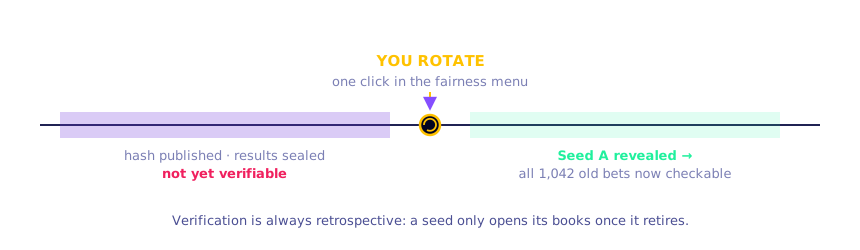
Rotating your server seed does two things: it retires the seed pair you have been betting under, and it forces the site to reveal the raw server seed it committed to — which is the only moment your past bets become verifiable. Rotate at the end of every session, then check the closed seed in one batch. It has no effect whatsoever on your future results.
What actually happens when you rotate?
Three things, in one action. The active server seed is retired and its raw value is published — until now you had only its SHA-256 hash. A new server seed takes over, and you are shown its hash, the commitment for everything you bet next. And your nonce resets to 0, starting a fresh count under the new pair. From this moment, every bet you made under the old seed can be recomputed and compared against what the site showed you at the time — the full procedure is in How to Verify a Provably Fair Roll.
Why won't the site reveal the seed while it's active?
Because the secrecy is load-bearing. With the raw server seed, your client seed and the current nonce, anyone can compute every future result — that is the whole point of the scheme, and it is exactly what you do retroactively when verifying. Revealed early, it would let you bet only on rolls you already knew you would win. So the protocol is strict: hash now, seed later, and never both for an active pair. A site that shows you a raw active seed has broken its own game; a site that never reveals retired seeds has broken yours.
When should you rotate?
- At the end of every session. This is the audit habit worth building: close the seed, verify the batch, done. Unverified sessions are sessions you took on faith.
- After any bet that matters to you. Won or lost something significant? Rotate and check it while the details are fresh and screenshotted.
- The moment something feels off. A result that contradicts what you saw, a client that lagged at a suspicious moment — rotate immediately so the seed in question is locked and revealed.
- Before you withdraw and leave a site. A seed you never rotate is a seed the site never has to reveal — close it out while you still have access to your bet history.
- Not mid-session for luck. There is no luck to manage — see below.
One practical habit to pair with rotation: note your last nonce and screenshot the committed hash before you rotate. The nonce tells you exactly how many bets the closed seed must account for, and the screenshot is your evidence if the revealed seed fails the commitment check. Some implementations also rotate seeds automatically after a set number of bets or on a schedule — check the site's fairness page so an unexpected rotation does not look like tampering when it is just housekeeping.
How do I verify a whole closed seed in batch?
One rotation unlocks an entire seed history, so check it as one unit rather than bet by bet. First confirm the commitment — SHA-256 of the revealed seed must equal the hash you were shown up front. Then recompute every nonce from 0 to your last bet:
for nonce in 0..lastBet:
    resultHex = HMAC-SHA256(serverSeed, clientSeed + ':' + nonce)
    outcome   = game mapping of first bytes
    compare against bet history[nonce]
Gaps matter too: if your history shows 300 bets, the nonces should run 0 through 299 with nothing missing. Doing this by hand is exactly the tedium our provably fair verifier exists to remove — paste the seed pair and a nonce range, and it recomputes the session in your browser. The byte-level detail of what it computes is in Server Seed, Client Seed, Nonce — Explained Byte by Byte.
Does rotating change my luck?
No. The next server seed was generated — and its hash committed — before you rotated, and every result under it is uniformly random no matter when you switched. The same goes for changing your client seed: it changes which random results you get, not their distribution, and the house edge is identical either way. A cold streak that ends right after you rotate would have ended anyway; a hot streak you credit to a fresh seed is variance wearing a costume. Rotate for auditability, never for outcomes. Anyone selling seed-timing strategies is selling noise.
What if a site won't let me rotate — or never reveals the old seed?
Then its provably fair page is theater. Commit-reveal without the reveal proves nothing: a hash you can never check against a revealed seed is just a decorative string. Sites with serious implementations document rotation and reveal openly — CSGORoll publishes its scheme and verification code, and Gamdom exposes round data for its originals. Contrast that with sites where fairness claims cannot be traced to any committed hash at all — when we reviewed Crash GG we found no independently verifiable fairness documentation, which is exactly the situation rotation-plus-reveal exists to prevent. Treat a missing or unrevealable seed as a red flag worth more than any badge on the homepage.
Rotation proves your past bets were computed fairly; it does not make them good bets. The paytable decided that long before any seed existed, and that is a separate article.